

When working with electronics, diagnostics, or electrical repairs, understanding the difference between a multimeter and a voltmeter is essential. Beginners often encounter both tools early in their journey, and even experienced professionals rely on them for quick, accurate electrical measurements. However, each instrument serves a distinct role, and choosing the right one can impact both the quality and safety of your work. This article offers a comprehensive, beginner-friendly guide to the similarities, differences, and advanced uses of multimeters and voltmeters, equipping you with the knowledge to confidently select and use these indispensable tools.
Whether you’re troubleshooting a household appliance, designing a new circuit, or performing routine maintenance on industrial equipment, knowing when to use a multimeter or a voltmeter can save time, prevent damage, and ensure precise results. In my experience, making informed decisions about test instruments leads to safer work environments and more reliable outcomes.
This guide combines foundational explanations with advanced strategies, catering to learners at every stage and offering actionable insights you can apply immediately.
Key Takeaways
- Multimeters measure multiple electrical parameters (voltage, current, resistance), while voltmeters measure only voltage.
- Multimeters offer greater versatility, making them suitable for a wider range of troubleshooting and diagnostic tasks.
- Voltmeters provide simplicity and precision for dedicated voltage measurements, often in laboratory or calibration settings.
- Understanding correct usage and limitations of each tool is critical for safety and measurement accuracy.
- Advanced functions in modern multimeters (such as data logging, auto-ranging, and capacitance testing) extend their usefulness well beyond voltage measurement.
- Selecting the right instrument depends on application, required accuracy, and user experience level.

Credit: www.fluke.com
Understanding Multimeters
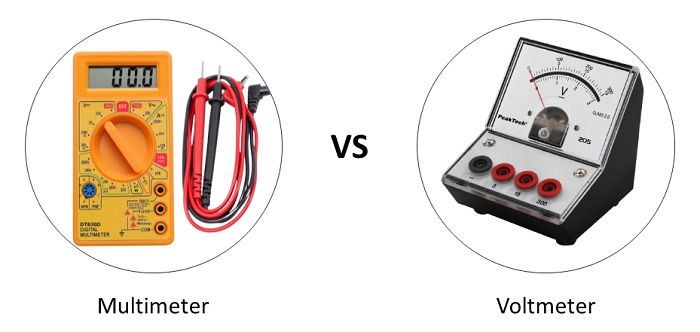
A multimeter is a handheld instrument designed to measure several electrical properties within a circuit. It combines the functionality of multiple devices (voltmeter, ammeter, and ohmmeter) into one compact unit, making it a staple for anyone working with electronics.
Types Of Multimeters
Multimeters are categorized into two main types:
- Analog Multimeters: Use a moving coil meter and needle display. They offer real-time trend visualization but can be harder to read accurately.
- Digital Multimeters (DMMs): Provide readings on a digital display, offering higher accuracy, ease of use, and advanced features.
Digital multimeters are now the industry standard due to their reliability and robust functionality.
Core Functions
A typical multimeter can measure:
- Voltage (DC and AC)
- Current (DC and AC)
- Resistance
Advanced models may also measure:
- Capacitance
- Frequency
- Temperature
- Continuity
- Diode testing
How Multimeters Work
Multimeters use internal circuits to connect to the component or circuit being tested. By selecting the appropriate mode and range, users can safely measure the desired parameter. The display then provides an instant reading. Safety features, such as fused inputs and overload protection, are often included to protect both the user and the device.
Example: Using A Multimeter To Diagnose A Faulty Circuit
Suppose a household light fixture fails to turn on. A technician can use a multimeter to:
- Check for voltage at the fixture
- Test continuity of the switch
- Measure current flow
This multi-faceted approach quickly pinpoints the issue, demonstrating the value of a multimeter over a single-purpose voltmeter.

Credit: www.youtube.com
Understanding Voltmeters
A voltmeter is a specialized instrument designed solely to measure the electrical potential difference, or voltage, between two points in a circuit. Voltmeters are essential for ensuring that circuits operate at the correct voltage and for diagnosing faults.
Types Of Voltmeters
- Analog Voltmeters: Feature a needle that moves over a calibrated scale. They are valued for their immediate feedback but may lack precision.
- Digital Voltmeters: Display voltage readings numerically, reducing user error and increasing accuracy.
How Voltmeters Work
Voltmeters connect in parallel with the circuit element whose voltage is being measured. They feature a high internal resistance, ensuring they draw minimal current and do not significantly alter the circuit’s operation.
Example: Checking Battery Voltage With A Voltmeter
A user can check whether a car battery needs replacement by connecting a voltmeter across its terminals. A healthy 12V battery should read around 12. 6V when fully charged. Lower readings indicate a need for charging or replacement.
When To Use A Voltmeter
Voltmeters are ideal when:
- Only voltage measurements are needed
- High precision is required
- Simplicity and ease of use are important
Multimeter Vs Voltmeter: Core Differences
While both instruments are used to measure voltage, they differ significantly in function, design, and use cases. The following table summarizes their core differences:
| Feature | Multimeter | Voltmeter |
|---|---|---|
| Measurement Parameters | Voltage, current, resistance (and more) | Voltage only |
| Versatility | High | Low |
| Display Type | Analog or digital | Analog or digital |
| Internal Resistance | High (in voltage mode) | Very high |
| Typical Use | General diagnostics, repair, education | Precision voltage measurement |
| Complexity | Moderate to high | Low |
| Cost | Moderate to high | Low to moderate |
Measurement Capability
- Multimeters can measure multiple parameters, making them suitable for troubleshooting complex issues.
- Voltmeters focus solely on voltage, often with higher input impedance for precision.
Application Scope
- Multimeters are found in almost every electrician’s toolkit.
- Voltmeters are more common in laboratories and calibration environments.
User Experience
- Beginners may prefer voltmeters for straightforward voltage checks.
- Experienced users and professionals rely on multimeters for their broad capabilities.
Example: Field Vs Lab Measurement
In the field, a multimeter allows a technician to check voltage, current, and resistance without switching instruments. In a calibration lab, a dedicated voltmeter might be used for its higher accuracy and stability.
Credit: www.tutorialspoint.com
How To Use A Multimeter For Voltage Measurement
Learning to use a multimeter for voltage measurement is an essential skill for anyone working with electronics or electricity. Follow these beginner-friendly steps for safe and accurate results.
Step 1: Select The Voltage Measurement Mode
- Turn the dial to the V symbol (with a straight line for DC, wavy for AC).
- Choose the appropriate voltage range if your device is not auto-ranging.
Step 2: Prepare The Probes
- Insert the black probe into the COM (common) port.
- Insert the red probe into the port marked for voltage (often labeled VΩmA).
Step 3: Connect To The Circuit
- Touch the black probe to the circuit’s ground or negative terminal.
- Touch the red probe to the point where you wish to measure voltage.
Step 4: Read The Measurement
- The value will appear on the display. For safety, never exceed the maximum input voltage specified by the multimeter.
Example: Measuring A 9v Battery
- Set the multimeter to DC voltage.
- Place the black probe on the battery’s negative terminal, red on the positive.
- Read the voltage. If it’s below 8.4V, the battery may be weak.
Pro Tip:
Always start with the highest voltage range if your multimeter is not auto-ranging. This prevents accidental overload and protects the meter.
Safety Tips
- Never measure resistance or continuity on a live circuit.
- Always check probe condition and insulation.
- Remove probes from the meter when not in use.
How To Use A Voltmeter
Voltmeters are easier to use due to their single-purpose design. However, precision and safety still require attention.
Step 1: Set Up The Voltmeter
- Set the selector switch to the desired voltage type (AC or DC).
- Connect the test leads to the appropriate terminals.
Step 2: Connect In Parallel
- Place the voltmeter leads across the two points where voltage is to be measured.
- Ensure firm and stable contact to avoid fluctuating readings.
Step 3: Interpret The Results
- Read the value directly from the display.
- If the reading is negative, reverse the leads for correct polarity (for DC measurements).
Example: Testing A Power Outlet
Plug the voltmeter leads into the outlet’s two slots. A standard US outlet should read approximately 120V AC. Deviations may indicate wiring problems.
Pro Tip:
Use a voltmeter with a high input impedance for sensitive electronic circuits to prevent drawing current and affecting the circuit operation.
Advanced Multimeter Features And Suggestions
Modern digital multimeters are packed with advanced features that extend their utility beyond basic measurements. Leveraging these capabilities can save time, improve accuracy, and open new troubleshooting strategies.
Auto-ranging
Auto-ranging simplifies measurements by automatically selecting the best range for the detected signal. This eliminates guesswork and reduces the risk of user error.
Data Logging
Some multimeters can log measurements over time. This is especially useful for monitoring voltage fluctuations or diagnosing intermittent problems. For example, a multimeter with logging can track voltage drops in a solar panel system throughout the day.
Capacitance And Frequency Measurement
Advanced multimeters can measure capacitance (useful for checking capacitors in AC units or power supplies) and frequency (critical in audio and communications work).
Temperature Measurement
Certain models include a thermocouple input, allowing direct temperature readings. This feature is invaluable for monitoring components that heat up during operation.
True Rms Measurement
True RMS multimeters provide accurate readings for non-sinusoidal AC signals, essential in industrial and variable-speed drive environments.
Example: Diagnosing A Variable-speed Motor
A basic multimeter may report incorrect voltage readings on a motor with a non-standard waveform. A True RMS multimeter ensures accurate voltage measurement, preventing misdiagnosis.
Pro Tip:
If you regularly work with complex or high-frequency signals, invest in a True RMS multimeter with advanced data logging. This upgrade pays dividends in accuracy and diagnostic speed.
Real-world Examples And Case Studies
Understanding the practical impact of choosing the right instrument can clarify their differences. Here are several real-world scenarios:
Case Study 1: Automotive Diagnostics
An auto mechanic uses a multimeter to diagnose why a car won’t start. By checking battery voltage, starter current, and continuity of wiring, the mechanic quickly identifies a faulty ground connection. A voltmeter alone would only reveal battery voltage, potentially missing other faults.
Case Study 2: Electronics Lab Precision
A university laboratory requires precise measurement of reference voltages in analog circuits. Here, a high-quality digital voltmeter is chosen for its stability and accuracy. The simplicity ensures that students focus on circuit theory without worrying about additional settings or measurements.
Case Study 3: Industrial Equipment Maintenance
During routine maintenance, an industrial electrician uses a multimeter to check control voltages, test relay coil resistance, and verify current draw in motors. The flexibility of a multimeter streamlines troubleshooting and minimizes downtime.
Example: Home Appliance Repair
A homeowner suspects a faulty power supply in a microwave oven. Using a multimeter, they confirm the outlet voltage, test fuse continuity, and check transformer resistance, all with one tool.
Key Factors To Consider When Choosing Between Multimeter And Voltmeter
Selecting the right instrument involves evaluating several factors based on your application and experience level.
Measurement Needs
- If you only need to measure voltage, a voltmeter is sufficient.
- If you require current or resistance measurement, a multimeter is necessary.
Accuracy And Precision
- For tasks demanding high precision (e.g., calibration, lab work), choose a dedicated voltmeter with high input impedance and fine resolution.
- For general troubleshooting, most multimeters provide adequate accuracy.
Ease Of Use
- Beginners may prefer the simplicity of a voltmeter.
- Multimeters, while more complex, offer greater versatility for those willing to learn.
Cost Considerations
- Voltmeters are generally less expensive than multimeters.
- Investing in a quality multimeter can save money long-term by replacing multiple tools.
Durability And Build Quality
- For fieldwork, select a rugged multimeter with drop resistance and dust/water protection.
- For bench-top or lab use, a high-precision voltmeter may be more appropriate.
Example: Education Setting
In schools, analog voltmeters are often used to teach basic circuit principles due to their simplicity and immediate feedback. Advanced students may transition to multimeters for more complex experiments.
Pro Tip:
For beginners, start with a reliable entry-level digital multimeter. As your skills develop, upgrade to models with features that match your specialization, such as True RMS, data logging, or Bluetooth connectivity.
Common Mistakes And How To Avoid Them
Even experienced users can make mistakes when working with these instruments. Here are some pitfalls and best practices:
Mistake 1: Using The Wrong Measurement Mode
Setting a multimeter to current or resistance mode when measuring voltage can damage the meter or the circuit.
Solution: Double-check the dial setting and probe connections before measuring.
Mistake 2: Incorrect Probe Placement
Connecting probes in series instead of parallel with the circuit for voltage measurement leads to incorrect readings.
Solution: Always connect across (parallel to) the component or power source for voltage.
Mistake 3: Ignoring Maximum Ratings
Exceeding the voltage or current rating of your meter can cause internal damage or hazardous situations.
Solution: Consult the user manual and stay within specified limits.
Mistake 4: Not Accounting For Internal Resistance
A voltmeter with insufficiently high input impedance can draw current, altering circuit behavior and leading to inaccurate readings.
Solution: Use a voltmeter or multimeter with at least 10 MΩ input impedance for electronic circuits.
Mistake 5: Neglecting Safety Precautions
Working on live circuits without proper precautions can result in shock, injury, or damage to equipment.
Solution: Wear appropriate personal protective equipment (PPE), disconnect power when possible, and follow safety protocols.
Example: Preventing Blown Fuses
When measuring current, always move the red probe to the correct terminal and start with the highest range. Forgetting this step can blow the meter’s fuse.
Comparison Table: Multimeter And Voltmeter Use Cases
A visual summary of typical use cases helps clarify when each tool is most effective.
| Scenario | Multimeter Advantage | Voltmeter Advantage |
|---|---|---|
| Home appliance troubleshooting | ✓ (tests voltage, continuity, resistance) | |
| Lab voltage calibration | ✓ (high precision, stability) | |
| Automotive electrical diagnostics | ✓ (voltage, current, continuity) | |
| Educational demonstrations | ✓ (multiple measurements for experiments) | ✓ (simple voltage checks) |
| Industrial equipment maintenance | ✓ (comprehensive testing in one tool) | |
| Battery voltage testing | ✓ (quick voltage check) | ✓ (single-function simplicity) |
Calibration And Maintenance
Proper calibration and maintenance are essential for both multimeters and voltmeters to ensure reliable measurements and safety.
Calibration Procedures
- Factory Calibration: Most new instruments are factory-calibrated. For precise work, consider annual recalibration by an accredited lab.
- User Calibration: Some advanced multimeters and voltmeters offer user-accessible calibration. Always follow manufacturer instructions and use certified reference standards.
Maintenance Best Practices
- Store meters in a dry, dust-free environment.
- Regularly inspect probes and leads for wear or damage.
- Replace batteries as needed to avoid leakage.
- Clean instrument surfaces with a soft, dry cloth.
Example: Recognizing Calibration Drift
After several years, a multimeter may begin reporting voltages slightly off from known standards. Periodic calibration ensures ongoing accuracy, which is critical in professional and laboratory settings.
Pro Tip:
Keep your calibration certificates up to date, especially in regulated industries or educational labs.
Internal Circuit Differences: Technical Perspective
For advanced users and those interested in the technical details, understanding the internal circuitry of multimeters and voltmeters can enhance troubleshooting and instrument selection.
Multimeter Internal Design
- Selector Switch: Routes the input signal to the correct measurement circuit.
- ADC (Analog-to-Digital Converter): Converts analog signals to digital values in DMMs.
- Shunt Resistors: Used for current measurement.
- Voltage Divider Networks: Scale input voltage for measurement.
- Microcontroller: Manages functions, display, and advanced features.
Voltmeter Internal Design
- High Input Impedance: Achieved with precision resistors or buffer amplifiers, minimizing current draw.
- Single Measurement Path: Simplifies circuit, reduces error sources.
Impact On Measurement
- Multimeters may introduce slightly higher measurement error due to their multifunction design.
- Voltmeters, optimized for voltage, can achieve better linearity and lower noise.
Example: Measuring Sensitive Circuits
In low-signal analog circuits, using a high-impedance voltmeter prevents signal loading, maintaining measurement fidelity.
Pro Tip:
When measuring millivolt-level signals or high-impedance nodes, opt for a laboratory-grade voltmeter or a multimeter with a >10 MΩ input impedance.
Frequently Asked Questions
What Is The Input Impedance Of A Typical Digital Multimeter Versus A Voltmeter?
Digital multimeters usually have an input impedance of 10 MΩ or higher when measuring voltage. Precision voltmeters, particularly in laboratory applications, may have even higher input impedance (up to 1 GΩ), minimizing their impact on sensitive circuits.
Can I Use A Multimeter As A Voltmeter?
Yes, a multimeter in voltage measurement mode functions as a voltmeter. However, for applications requiring extremely high accuracy or low noise, a dedicated voltmeter may provide better performance.
Are Analog Meters Still Useful Compared To Digital Ones?
Analog meters can be valuable for observing trends or rapidly changing signals, as the needle provides immediate feedback. They are still used in educational settings and for certain troubleshooting tasks, though digital meters now dominate most applications due to their accuracy and additional features.
How Often Should I Calibrate My Multimeter Or Voltmeter?
For general use, annual calibration is recommended. In critical environments (such as laboratories or industrial quality assurance), follow the manufacturer’s guidelines and industry standards, which may require more frequent calibration. Always use accredited calibration services.
What Safety Certifications Should I Look For When Buying A Multimeter Or Voltmeter?
Look for meters that comply with standards such as CAT II/III/IV safety ratings, UL, or IEC certifications. These indicate robust protection against overvoltage, surges, and other hazards. More information is available from the Wikipedia Category Rating page.
Further Learning And Resources
To enhance your understanding and stay current with best practices, explore additional resources:
- Official guides and tutorials from the American National Standards Institute (ANSI) and International Electrotechnical Commission (IEC)
- Manufacturer manuals and training videos (e.g., Fluke, Extech)
- Online courses, such as those offered by Coursera, covering basic and advanced electrical measurements
- Community forums like EEVblog and All About Circuits for peer advice and troubleshooting
Mastering the use of multimeters and voltmeters is a vital skill for anyone working with electronics, from beginners to seasoned professionals. By understanding their differences, capabilities, and best practices, you’ll be better equipped to tackle electrical challenges with confidence and precision.
As your expertise grows, continue exploring advanced measurement techniques and always prioritize safety and accuracy in every task.