
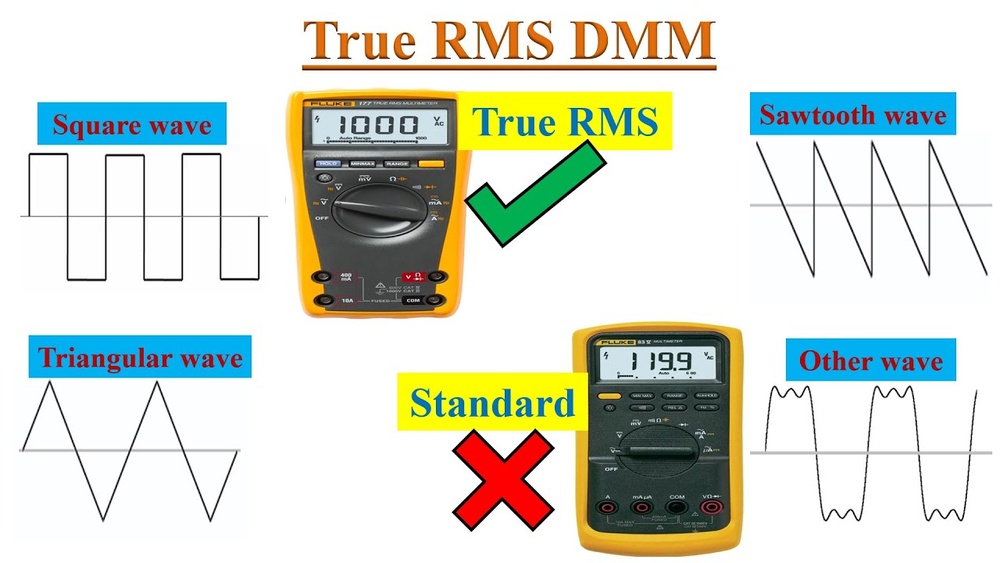
When troubleshooting electrical systems or working on electronics, the quality and accuracy of your measurements can make the difference between a successful project and a costly mistake. Multimeters, the go-to tool for measuring voltage, current, and resistance, come in various types, but a critical distinction exists between True RMS (Root Mean Square) multimeters and their normal (average-responding) counterparts. Understanding how these devices interpret signals is vital for both beginners and seasoned professionals.
For those just starting out, the differences may seem technical or subtle, but as you advance in your electrical work, the distinction becomes crucial, especially when dealing with complex, non-sinusoidal waveforms generated by modern electronic devices. Whether you’re a hobbyist, a student, or a working technician, this guide will break down the science, practical implications, and advanced tips for choosing and using True RMS versus normal multimeters.
Key Takeaways
- True RMS multimeters provide accurate readings for both sinusoidal and non-sinusoidal AC signals, while normal multimeters are only accurate with pure sine waves.
- The choice between True RMS and normal meters affects the reliability of your measurements, especially with modern electronic devices.
- Beginners can safely use normal multimeters for simple, resistive loads, but advanced users should opt for True RMS models for professional accuracy.
- Real-world scenarios, such as troubleshooting variable speed drives or modern power supplies, highlight the critical need for True RMS accuracy.
- Understanding the internal workings, cost differences, and practical applications ensures you select the right tool for your needs.
Understanding Multimeter Measurement Principles
What Is A Multimeter?
A multimeter is a handheld instrument designed to measure basic electrical parameters: voltage, current, and resistance. Modern digital models also measure continuity, capacitance, frequency, and temperature. Multimeters are essential for anyone working with electronics, from checking batteries to diagnosing household wiring.
Types Of Multimeters
There are two main categories:
- Analog Multimeters: Use a needle and dial; less common today but useful for observing trends in fluctuating signals.
- Digital Multimeters (DMMs): Provide numeric readings on an LCD; most widely used due to accuracy, ease of use, and additional features.
How Multimeters Measure Ac Signals
When measuring alternating current (AC), the waveform can be:
- Sinusoidal: Standard power from the grid, smooth, repetitive.
- Non-sinusoidal: Includes spikes, harmonics, or irregular shapes, common in devices like computers, LED lighting, or motor drives.
The way a multimeter interprets these waveforms is critical, which leads to the True RMS versus normal debate.
Credit: www.promaxelectronics.com
True Rms Vs Normal Multimeter: Technical Differences
What Does Rms Mean?
RMS (Root Mean Square) is a mathematical technique that expresses the equivalent value of an AC signal in terms of DC voltage or current. It reflects the actual energy delivered by the AC signal.
- True RMS Value: Calculated using the formula \(\sqrt{\frac{1}{T}\int_0^T [f(t)]^2 dt}\), where \(f(t)\) is the instantaneous value over time \(T\).
- Average-Responding Value: Measures the average of the absolute value of the waveform, then scales it (usually by 1.11 for sine waves) to estimate RMS.
How Normal Multimeters Work
Normal (Average-responding) multimeters assume every AC waveform is a perfect sine wave. They:
- Rectify the signal (convert AC to DC).
- Average the absolute value.
- Multiply by a fixed conversion factor (1.11) to display an “RMS” value.
This method works only for pure sine waves. If the waveform is not sinusoidal, the reading can be significantly inaccurate.
How True Rms Multimeters Work
True RMS multimeters perform complex calculations (often via integrated circuits) to derive the actual RMS value, regardless of waveform shape.
- Sample the waveform at high speed.
- Square each sample.
- Average the squared values.
- Take the square root of the result.
This ensures accurate readings for both sinusoidal and non-sinusoidal signals.
Comparison Table: True Rms Vs Normal Multimeters
| Feature | True RMS Multimeter | Normal Multimeter |
|---|---|---|
| AC Waveform Accuracy | Accurate for all waveforms | Accurate only for sine waves |
| Signal Types | Sinusoidal & non-sinusoidal | Sinusoidal only |
| Internal Calculation | True RMS algorithm | Average-responding (with scaling) |
| Cost | Higher | Lower |
| Use in Industrial Settings | Essential | Limited |
| Best For | Professionals, advanced users | Beginners, simple tasks |

Credit: www.youtube.com
When Does True Rms Matter?
Modern Electronics And Non-sinusoidal Waveforms
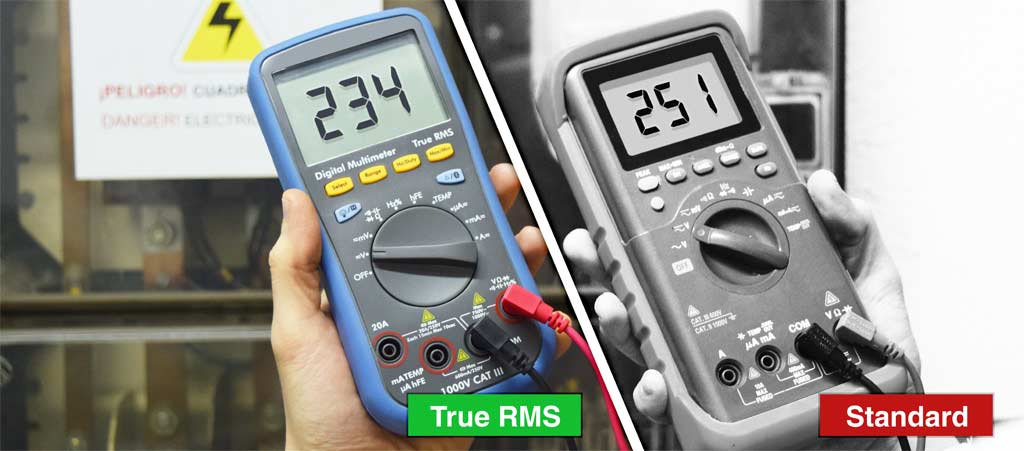
Many contemporary devices, like computers, LED drivers, variable speed motor controls, draw distorted current waveforms. These are not pure sine waves and contain harmonics or sharp spikes. Measuring such signals with a normal multimeter can yield errors of 20% or more.
Example: If you measure the output of a computer power supply (with lots of harmonics) using a normal multimeter, you might read 80V when the actual RMS value is 100V, a 20% error.
Case Study: Industrial Motor Drives
Variable Frequency Drives (VFDs) used for controlling industrial motors generate pulse-width modulated (PWM) waveforms. Only a True RMS meter can accurately measure the output voltage or current in these systems. Using a normal meter could lead to misdiagnosis or improper adjustments.
Safety And Compliance
In safety-critical environments, such as medical equipment servicing or power quality analysis, correct RMS readings are mandatory. An incorrect reading can lead to equipment malfunction or even safety hazards.
Practical Examples
- Residential Wiring: For wall outlets (simple sine waves), a normal meter suffices.
- Troubleshooting LED Lighting: LED drivers often produce non-sinusoidal currents; True RMS is needed for accuracy.
- Measuring Power Tools: Devices with speed controls create distorted waveforms, only True RMS multimeters provide reliable readings.
Credit: www.electro-tech-online.com
Pros And Cons Of True Rms And Normal Multimeters
Advantages Of True Rms Multimeters
- Accurate measurement of all waveform types
- Suitable for complex, modern electronics
- Reduces troubleshooting errors
- Essential for compliance testing
Disadvantages Of True Rms Multimeters
- Higher cost (often double the price of normal meters)
- May require more battery power
- Slightly more complex circuitry (potentially less robust in budget models)
Advantages Of Normal Multimeters
- Affordable and widely available
- Simpler operation, good for beginners
- Adequate for basic AC measurements (resistive loads)
Disadvantages Of Normal Multimeters
- Inaccurate with non-sinusoidal waveforms
- Not recommended for troubleshooting modern devices
- Can lead to misleading results in advanced applications
Comparison Table: Situational Suitability
| Use Case | True RMS Recommended? | Normal Meter Sufficient? |
|---|---|---|
| Household wall outlet | No | Yes |
| Measuring LED lamp current | Yes | No |
| Testing VFD outputs | Yes | No |
| Checking battery voltage | No (DC measurement) | Yes |
| Audio amplifier output | Yes | No |
How To Choose The Right Multimeter For Your Needs
Assess Your Typical Measurements
- Pure Sine Wave Applications: If you mostly measure household AC or batteries, a normal multimeter is sufficient.
- Modern Electronics or Industrial Equipment: If you work with variable speed drives, switching power supplies, or non-linear loads, opt for a True RMS model.
Budget Considerations
True RMS multimeters are typically 20%, 100% more expensive than normal models. For beginners or students, a basic normal multimeter ($10, $20 range) is a good start. Professionals or advanced hobbyists should invest in a True RMS meter (often $40+ for reputable brands).
Features To Look For
- Auto-ranging capability for easier operation
- Backlit display for visibility
- Data hold and min/max recording
- Safety ratings (CAT II, III, IV) for high-energy environments
- Additional functions: Temperature, frequency, capacitance, diode testing
Brand And Reliability
Choose established brands like Fluke, Keysight, or Klein Tools for durability, accuracy, and safety. Cheaper, unbranded models may lack internal protection and accuracy.
Example: Selection For A Small Workshop
In my experience, running a small electronics repair workshop, I started with a normal multimeter. However, as projects involved more switching power supplies and motor controls, upgrading to a True RMS unit eliminated confusion over inconsistent readings and improved diagnostic accuracy.
Advanced Measurement Tips And Best Practices
Understanding Crest Factor
Crest factor is the ratio of a waveform’s peak value to its RMS value. High crest factors (common in electronic loads) challenge many meters. High-quality True RMS meters specify a crest factor they can handle (typically 3:1 or higher).
- Pro Tip: When measuring signals with high peaks (e.g., switching power supplies), check your meter’s crest factor rating in the user manual.
Harmonics And Power Quality
Non-sinusoidal currents introduce harmonics, integer multiples of the base frequency. These can distort measurements.
- Use True RMS meters to capture the total heating effect (important for power quality analysis).
- For detailed harmonic analysis, consider a power quality analyzer.
Measuring Small Currents Or Voltages
True RMS meters can sometimes be less sensitive to very low-level signals due to internal noise. For microamp or millivolt measurements, check the meter’s resolution and accuracy specs.
- Example: If troubleshooting sensitive audio equipment, select a meter with high resolution and True RMS capability.
Avoiding Measurement Errors
- Always set the correct function (AC vs DC) before measuring.
- For high-voltage or industrial work, ensure your meter has proper CAT safety ratings.
- Replace test leads if insulation is damaged.
Calibration And Maintenance
Accurate measurements depend on calibration. Have your meter checked and calibrated periodically, especially if used in professional settings.
- Pro Tip: Keep a calibration sticker on your meter and note the next due date.
Real-world Applications And Case Studies
Case Study 1: Hvac Technician Diagnosing Variable Speed Blowers
An HVAC technician was called to investigate an air handler with a variable speed blower. Using a normal multimeter, the technician consistently measured lower than expected voltage outputs, resulting in unnecessary motor replacements. After switching to a True RMS meter, the readings matched the manufacturer’s specifications, confirming the original motor was functioning correctly.
Case Study 2: Electronics Student Testing Power Supplies
A student building a custom power supply noticed discrepancies between calculated and measured output voltages when using a normal multimeter. After borrowing a True RMS meter, the readings aligned with theoretical expectations, revealing the importance of proper measurement tools in educational settings.
Case Study 3: Industrial Electrician Troubleshooting Harmonics
An industrial electrician was tasked with power quality analysis in a facility with significant non-linear loads (welders, drives, and computers). The electrician’s True RMS meter provided accurate current and voltage values, enabling correct sizing of circuit breakers and prevention of nuisance tripping.
Common Pitfalls And How To Avoid Them
Misinterpreting Meter Readings
- Beginner Mistake: Trusting a normal meter reading for all AC signals.
- Solution: Use True RMS meters for non-sinusoidal waveforms.
Ignoring Meter Specifications
- Always review the user manual for measurement limits, especially maximum voltage, current, and crest factor.
Using Old Or Damaged Meters
- Replace old meters that lack proper insulation or safety features.
- Regularly inspect and test leads for wear.
Pro Tip:
If you frequently encounter modern electronics with switching supplies, variable speed motors, or dimmers, invest in a True RMS meter early. It saves time and prevents incorrect diagnostics.
Internal Circuit Differences And How They Affect Accuracy
The Electronics Behind The Measurement
- Normal Multimeter Circuitry: Utilizes a simple rectifier and averaging circuit, followed by analog-to-digital conversion.
- True RMS Multimeter Circuitry: Incorporates additional RMS-conversion ICs or digital signal processors (DSPs) for accurate waveform analysis.
Impact On Speed And Battery Life
- True RMS processing consumes more power and can be slightly slower in response time, especially in budget models.
- High-end True RMS meters optimize processing for both speed and battery efficiency.
Example: Measurement Lag
When measuring rapidly fluctuating AC signals, a normal multimeter may respond faster but inaccurately. A quality True RMS meter balances speed and accuracy, displaying the true energy content of the waveform.
Cost Analysis And Value Proposition
Price Range Overview
- Normal Multimeters: $10, $30
- True RMS Multimeters: $40, $200+ (depending on brand and features)
Long-term Value
While True RMS meters carry a higher upfront cost, they reduce misdiagnosis, equipment damage, and wasted time in advanced or professional contexts.
Table: Cost Vs. Feature Comparison
| Feature | Entry-Level Normal | Mid-Range True RMS | High-End True RMS |
|---|---|---|---|
| Price Range | $10, $30 | $40, $100 | $100, $300 |
| Waveform Accuracy | Sine only | All | All |
| Functions | Basic | Advanced | Professional/Industrial |
| Safety Ratings | CAT II/III | CAT III/IV | CAT IV, IP-rated |
| Warranty | 6, 12 months | 1, 3 years | 3, 5 years |
When To Upgrade
- Upgrade when moving from hobby projects to professional work.
- If you encounter unexplained measurement discrepancies, a True RMS meter may be necessary.
Frequently Asked Questions
What Is The Main Reason To Choose A True Rms Multimeter Over A Normal One?
The primary reason is accuracy with non-sinusoidal waveforms. True RMS multimeters correctly measure the effective value of any AC waveform, while normal meters only provide accurate readings for pure sine waves. This is essential for working with modern electronics and power systems.
Can I Use A Normal Multimeter For Dc Measurements?
Yes, both normal and True RMS multimeters measure DC voltage and current with similar accuracy. The True RMS feature only applies to AC measurements, so for purely DC circuits, such as batteries or DC power supplies, a normal multimeter is sufficient.
Are There Any Risks In Using A Normal Meter On Non-sinusoidal Waveforms?
The main risk is misdiagnosis. A normal meter may display a significantly lower or higher value than the actual RMS voltage or current, leading to incorrect conclusions about circuit performance or safety. In critical applications, this can result in equipment damage or unsafe conditions.
How Do I Know If A Multimeter Is True Rms?
Check the meter’s specifications in the user manual or datasheet. The packaging or display will usually state “True RMS” if it is. Reputable manufacturers like Fluke or Keysight clearly label True RMS models. If unsure, consult the manufacturer’s website or documentation.
Is There A Way To Estimate The Error When Using A Normal Meter With Non-sinusoidal Signals?
While there’s no universal formula, the error depends on the waveform shape. For heavily distorted waveforms (e.g., switching power supplies), errors can exceed 20, 30%. Some advanced textbooks and technical references, such as the IEEE Power & Energy Magazine (see this article), detail methods for estimating errors based on harmonic content.
Resources For Further Learning
For deeper technical reading and waveform analysis, reputable sources include the Fluke Corporation’s application notes and the Wikipedia page on Root Mean Square (Wikipedia). Beginners and advanced users alike can benefit from hands-on experimentation and manufacturer tutorials.
Choosing between a True RMS and normal multimeter is more than a technical detail, it’s about ensuring your measurements are reliable and your work is safe. Beginners can confidently start with normal meters for simple tasks, but as your projects grow in complexity, investing in a True RMS model becomes not just an upgrade, but a necessity for professional results. Always match your tool to your application, consult trusted resources, and prioritize safety in every measurement.