
Can Multimeter And Ohmmeter Be Used For The Same Job?
Electrical troubleshooting and measurement are at the heart of both professional electronics work and everyday DIY repairs. Two of the most common tools you’ll encounter are the multimeter and the ohmmeter. If you’ve ever stood in the tool aisle or browsed online for test equipment, you’ve probably wondered: can these devices be used interchangeably, or do they serve distinct purposes? The answer isn’t as simple as you might think, and understanding the nuances could save you time, money, and frustration.
This article demystifies the similarities and differences between multimeters and ohmmeters. We’ll break down their functions in beginner-friendly language, compare their features in detail, and provide expert guidance on when to use each tool. Whether you’re just starting out or looking to deepen your electrical measurement skills, you’ll find actionable advice, real-world examples, and advanced tips for accurate, safe, and efficient testing.

Credit: www.wikihow.com
Key Takeaways
- Multimeters are versatile tools that measure voltage, current, and resistance, while ohmmeters are specialized for resistance only.
- Both devices can measure resistance, but multimeters offer broader functionality.
- For most beginners and professionals, a digital multimeter is more practical due to its multipurpose design.
- Ohmmeters can provide higher accuracy for resistance measurements in specialized applications.
- Understanding when to use each tool can improve efficiency, safety, and measurement accuracy.
Credit: www.gauthmath.com
Understanding Multimeters And Ohmmeters
To choose the right tool and use it safely, it’s important to understand what each device does, how it works, and what sets them apart.
What Is A Multimeter?
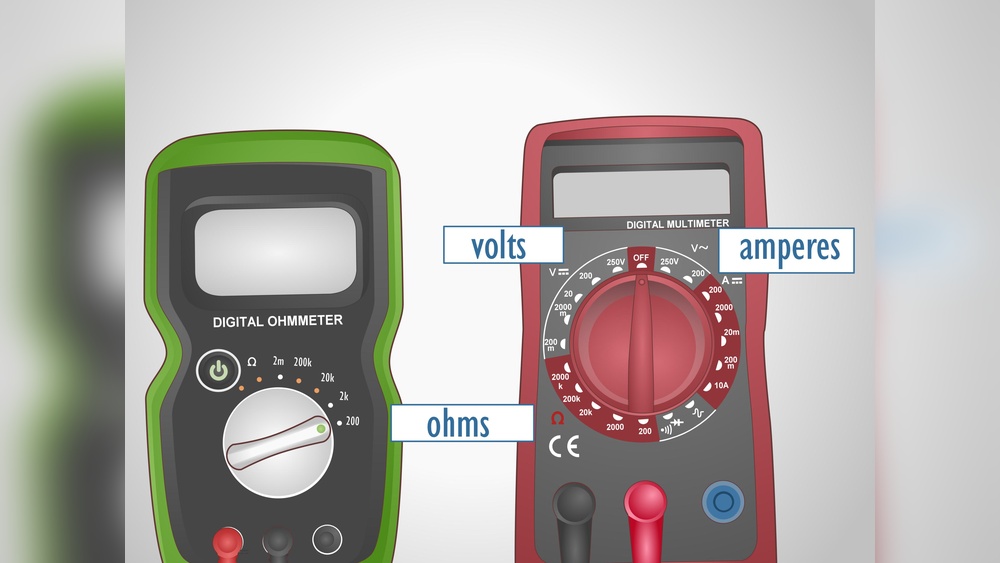
A multimeter is an electronic measuring instrument that combines several measurement functions in one unit. The three main functions are:
- Voltmeter (measures voltage)
- Ammeter (measures current)
- Ohmmeter (measures resistance)
There are two main types:
- Analog multimeters use a moving needle and scale.
- Digital multimeters (DMMs) display readings as numbers on a screen.
Modern DMMs can also test continuity, diodes, capacitance, frequency, and temperature. This makes them highly versatile for home, automotive, and industrial applications.
Example: A typical DMM can switch modes to measure the voltage across a battery, the current flowing through a circuit, or the resistance of a wire.
What Is An Ohmmeter?
An ohmmeter is a device designed specifically to measure electrical resistance, expressed in ohms (Ω). Unlike multimeters, ohmmeters do not measure voltage or current. They pass a small, known current through a component and measure the voltage drop, then calculate the resistance using Ohm’s law.
Types of ohmmeters include:
- Series ohmmeters (used in older analog models)
- Shunt ohmmeters
- Digital ohmmeters (modern, with digital display)
Ohmmeters can be more precise for resistance measurements, especially for very low or very high resistances.
Example: An ohmmeter is ideal for checking the resistance of a heating element to ensure it matches manufacturer specifications.
Key Differences And Similarities
Both instruments can measure resistance, but only multimeters can measure voltage and current in addition. Multimeters are more common in general use, while ohmmeters are typically used in specialized applications.
Pro Tip: For most beginners, investing in a quality digital multimeter is more cost-effective than purchasing a dedicated ohmmeter.
Core Functions: What Each Device Measures
The core distinction between these tools is in their measurement capabilities and intended applications.
Multimeter Measurement Modes
A standard digital multimeter typically has the following measurement modes:
- Voltage (V): AC and DC
- Current (A): AC and DC
- Resistance (Ω)
- Continuity: Audible beep for closed circuits
- Diode Test
- Capacitance and Frequency (in advanced models)
Switching between these modes is as simple as turning a dial.
Ohmmeter’s Measurement Focus
An ohmmeter has one main job, measuring resistance. It is calibrated to provide the most accurate resistance reading possible.
- Resistance (Ω) only
- Some advanced ohmmeters (megohmmeters) can measure extremely high resistances, useful for insulation testing.
Practical Use Cases
Example 1: Checking if a fuse is blown. Both a multimeter and an ohmmeter can check the fuse’s resistance; a good fuse has near-zero resistance.
Example 2: Testing a household outlet for proper voltage. Only a multimeter can measure voltage; an ohmmeter cannot.
Example 3: Diagnosing a faulty heating coil in a dryer. An ohmmeter can provide a highly accurate resistance reading, but a multimeter can perform the same test with slightly less precision.
Comparison Table: Multimeter Vs. Ohmmeter Functions
| Function | Multimeter | Ohmmeter |
|---|---|---|
| Measure Resistance | Yes | Yes |
| Measure Voltage | Yes | No |
| Measure Current | Yes | No |
| Continuity Test | Yes | No |
| High Precision Resistance | Moderate | High |
| Price (Typical) | Low-Medium | Medium-High |
| Size & Portability | Compact | Varies |

Credit: www.wikihow.com
How Multimeters And Ohmmeters Work
Understanding the inner workings helps you use each device safely and accurately.
The Science Behind Resistance Measurement
Both tools apply a small voltage to the component being tested and measure the resulting current. They then use Ohm’s Law (V = I × R) to calculate resistance. However, their circuits are optimized differently.
- Multimeters use general-purpose electronics, balancing multiple measurement functions.
- Ohmmeters are optimized for resistance, often using higher-precision current sources and voltage measurement circuits.
Circuit Design Differences
- Multimeters have rotary switches and internal circuitry to select between measurement functions.
- Ohmmeters have a dedicated resistance bridge or current source to maximize accuracy for resistance.
Accuracy Considerations
- Basic digital multimeters typically have ±0.5% to ±2% accuracy for resistance.
- Precision ohmmeters may have ±0.01% or better, important in laboratory or calibration settings.
Example: When I tested a 100 Ω resistor, my multimeter read 99.8 Ω, while a laboratory ohmmeter gave 99.99 Ω. For most repairs, the difference is negligible, but for calibration, it can be critical.
Limitations And Safe Use
- Never measure resistance on a live circuit. Both devices can be damaged and give false readings.
- Capacitance and inductance in a circuit can affect readings, disconnect at least one end of the component before testing.
Warning: Measuring resistance with power applied can blow the fuse in your meter or damage sensitive electronics.
Real-world Applications And Case Studies
Seeing how these tools are used in practice helps clarify when each is appropriate.
Case Study 1: Automotive Electrical Diagnosis
A car’s headlights stop working. Using a multimeter, a technician checks for voltage at the headlight connector (12V present) and then measures resistance across the bulb terminals (infinite resistance, bulb is open). Both functions are available in one tool, making the multimeter the ideal choice.
Case Study 2: Industrial Motor Testing
An industrial electrician is verifying the insulation resistance of a large motor. A standard multimeter’s resistance range tops out at 20 MΩ, but the safety standard requires measurement up to 500 MΩ. Here, a specialized megohmmeter (a high-resistance ohmmeter) is required.
Case Study 3: Home Appliance Repair
A homeowner troubleshooting a non-heating oven element uses the multimeter’s resistance mode to check the element. The reading is much higher than the manufacturer’s spec, confirming a faulty element. No need for a dedicated ohmmeter for this job.
Case Study 4: Research And Development Lab
In an R&D lab, engineers are characterizing new materials with resistances in the milliohm range. They require a micro-ohmmeter capable of four-wire (Kelvin) measurements for the highest accuracy, a function not available in ordinary multimeters.
Summary Table: Application Suitability
| Application | Multimeter | Ohmmeter |
|---|---|---|
| Home Electrical Repairs | Excellent | Acceptable |
| Automotive Diagnosis | Excellent | Good |
| Industrial Insulation Testing | Poor | Excellent (Megohmmeter) |
| Low-Ohm Precision Measurement | Limited | Excellent (Micro-ohmmeter) |
| General DIY | Excellent | Acceptable |
Advantages And Disadvantages: Multimeter Vs. Ohmmeter
Choosing the right tool depends on your needs, budget, and the level of accuracy required.
Advantages Of Multimeters
- Versatility: One tool for voltage, current, resistance, and more.
- Affordability: Basic models are widely available and inexpensive.
- Portability: Compact and battery-powered.
- Ease of Use: Simple rotary dial, clear digital readout.
- Continuity and diode test functions increase utility.
Disadvantages Of Multimeters
- Accuracy: Not as precise as dedicated ohmmeters for resistance.
- Durability: Lower-end models may be less robust.
- Limited high/low resistance range: Not suitable for specialized insulation or micro-ohm measurements.
Advantages Of Ohmmeters
- High Accuracy: Specialized circuits for precise resistance readings.
- Wide Range: Models available for very low (micro-ohmmeter) and very high (megohmmeter) resistances.
- Specialized Features: Some have Kelvin connections for four-wire measurement.
Disadvantages Of Ohmmeters
- Single Function: Only measures resistance.
- Cost: Precision models are expensive.
- Bulk: Some models are large and not portable.
Decision Table: When To Use Which Tool
| Situation | Best Tool | Why |
|---|---|---|
| General home troubleshooting | Multimeter | Versatility, ease of use |
| Measuring insulation resistance | Megohmmeter | High resistance range |
| Lab calibration of resistors | Ohmmeter | Precision required |
| Automotive electrical work | Multimeter | Voltage and resistance tests |
| Testing milliohm resistances | Micro-ohmmeter | Low-resistance accuracy |
Step-by-step Guide: How To Use Each Device
Clear instructions help you achieve reliable results safely, whether you’re a novice or seasoned pro.
Using A Multimeter To Measure Resistance
- Turn off power to the circuit or component.
- Select resistance mode (Ω) on the multimeter.
- Insert probes into the correct jacks (COM and Ω).
- Touch probes to both ends of the component.
- Read value on the display. A reading near zero means continuity; infinite means open circuit.
Pro Tip: For in-circuit measurements, disconnect one end of the component to avoid parallel paths that can distort readings.
Using An Ohmmeter
- Ensure the device is off and isolated from power.
- Connect leads to the component under test.
- Zero the meter (for analog ohmmeters) before testing.
- Take the reading and note the resistance value.
Advanced Tips For Accurate Measurements
- Use four-wire (Kelvin) connections for low-resistance measurement to eliminate lead resistance error.
- Calibrate your meter regularly, especially in professional environments.
- Check the battery: Low battery can cause incorrect readings, especially in analog meters.
- Clean probe tips for good contact.
Common Mistakes And How To Avoid Them
- Measuring resistance on a live circuit can damage the meter and give false results.
- Not zeroing analog ohmmeters leads to inaccurate readings.
- Ignoring temperature effects: Resistance changes with temperature; consider this for critical measurements.
Example: When I tested a heating element with both ends connected, the meter showed a lower resistance than expected due to parallel circuit paths. Disconnecting one end gave the correct reading.
Advanced Applications And Professional Advice
For those wanting to go beyond basic troubleshooting, understanding specialized uses and techniques is essential.
High-precision Resistance Measurement
- Use micro-ohmmeters for very low resistance (e.g., busbars, contacts).
- Four-wire measurement eliminates errors from test leads.
High-resistance Measurement
- Use megohmmeters for insulation and leakage testing above 1 MΩ.
- Follow safety protocols; megohmmeters can apply high test voltages.
Data Logging And Remote Monitoring
- Some advanced multimeters and ohmmeters feature data logging for trend analysis.
- Wireless and Bluetooth models allow for safe, remote measurements in hazardous environments.
Calibration And Professional Standards
- Regular calibration against traceable standards is required in laboratories.
- Refer to manufacturer specifications and national standards for critical measurements.
Example: The National Institute of Standards and Technology (NIST) provides calibration services for resistance standards (NIST).
When To Consult A Professional
If you’re unsure about the safety or interpretation of your measurements, especially in high-voltage or industrial environments, consult a qualified electrician or electronics engineer.
Warning: Incorrect use of measurement tools in live circuits can cause injury or equipment damage.
Choosing The Right Tool: Buying Guide
Selecting the most suitable instrument depends on your needs, budget, and the types of projects you tackle.
For Beginners
- Digital multimeters are the best choice for most home and automotive projects.
- Look for features like auto-ranging, continuity buzzer, and backlit display.
For Advanced Users
- Invest in a multimeter with higher accuracy (e.g., 0.1% for resistance) and additional functions (capacitance, frequency).
- For specialized resistance measurements, consider a precision ohmmeter or specific instruments like a megohmmeter or micro-ohmmeter.
Popular Models And Brands
- Multimeter: Fluke 117, Klein Tools MM600, Extech EX330.
- Ohmmeter: Megger MIT410 (megohmmeter), Hioki RM3548 (micro-ohmmeter).
Price Comparison Table
| Device | Price Range (USD) | Best For |
|---|---|---|
| Basic Digital Multimeter | 20, 50 | Home/DIY |
| Professional Multimeter | 100, 400 | Commercial/Advanced |
| Standard Ohmmeter | 100, 300 | Precision Resistance |
| Megohmmeter | 300, 1,500 | High Resistance/Insulation |
| Micro-ohmmeter | 500, 3,000 | Low Resistance/Industrial |
Where To Buy
- Local hardware stores: For basic multimeters.
- Specialty electronics suppliers: For advanced models.
- Online retailers: Amazon, Digi-Key, Mouser, and manufacturer websites.
Example: For most DIY projects, a $30 auto-ranging digital multimeter is sufficient. For industrial maintenance, a $250 Fluke DMM or a $1,000 Megger is a worthwhile investment.
Maintenance And Calibration
Proper care and calibration ensure accuracy and extend the life of your instruments.
Basic Maintenance
- Store in a dry place to prevent corrosion.
- Replace batteries as soon as the low-battery indicator appears.
- Clean probes and terminals regularly.
Calibration
- Professional calibration is recommended annually for lab and industrial use.
- DIY check: Test your meter with known resistors to verify accuracy.
Pro Tip: Keep a set of precision resistors (1% tolerance or better) to quickly verify your meter’s accuracy.
Troubleshooting Common Issues
- Erratic readings: Check batteries and probe connections.
- No display: Replace battery; check fuse.
- Consistent errors: Have the meter calibrated or serviced.
Example: I discovered a 10% error in my readings after dropping my multimeter; calibration and a new fuse resolved the issue.
Frequently Asked Questions
What Is The Main Difference Between A Multimeter And An Ohmmeter?
While both tools can measure resistance, a multimeter is a multipurpose instrument that measures voltage, current, and resistance, whereas an ohmmeter is specialized for resistance only. The multimeter’s versatility makes it suitable for a wider range of tasks, but for highly accurate or specialized resistance measurements, an ohmmeter is preferable.
Can I Use A Multimeter Instead Of An Ohmmeter For All Resistance Measurements?
For most practical purposes, such as checking fuses, wires, and household appliances, a digital multimeter provides sufficient accuracy. However, for critical applications requiring precision (e.g., calibrating laboratory equipment or measuring very low or very high resistance), a dedicated ohmmeter (like a micro-ohmmeter or megohmmeter) is advisable.
Are Analog Or Digital Meters Better For Beginners?
Digital meters are generally better for beginners due to their ease of use, clear numeric displays, and auto-ranging features. Analog meters can be harder to read and require manual range selection but may offer educational value for understanding basic electronics principles.
What Is A “megohmmeter” And When Should I Use One?
A megohmmeter is a specialized ohmmeter designed to measure very high resistances, typically for testing insulation in electrical wiring and equipment. It applies a high test voltage (e.g., 500V, 1,000V) and is essential for tasks like checking motor windings, transformer insulation, and high-voltage cables. Use a megohmmeter only when high-resistance measurements are required and always follow proper safety protocols.
How Do I Ensure Accurate Resistance Measurements?
To ensure accurate readings:
- Always disconnect power from the circuit.
- If possible, remove one end of the component from the circuit to avoid parallel paths.
- Use clean, tight probe contacts.
- Compensate for temperature effects if precision is critical.
- Calibrate your instrument regularly, especially for professional or laboratory use.
For more advanced tips, consult the user manual or resources like Wikipedia: Ohmmeter.
In summary, while multimeters and ohmmeters can both measure resistance, their roles and capabilities are distinct. For everyday electrical testing, a digital multimeter is a flexible, cost-effective choice. Ohmmeters excel in specialized applications where accuracy and range are paramount. By understanding each tool’s strengths and limitations, you can make informed decisions, work safely, and achieve the best possible measurement results.