

Is It Safe to Use a Multimeter on an Outlet? A Complete Guide for Beginners and Advanced Users
Electricity powers our daily lives, but it’s also one of the most misunderstood and potentially dangerous forces inside a home. Whether you’re a DIY enthusiast, a homeowner doing basic maintenance, or an electrical engineering student, you might wonder: Is it safe to use a multimeter on an outlet? This seemingly simple task can reveal a lot about your home’s wiring, but it can also pose risks if done incorrectly.
The thought of sticking probes into a wall socket can be intimidating, especially for beginners. However, with the right knowledge and technique, using a multimeter on an outlet is not only safe, it’s also one of the most effective ways to diagnose electrical issues and confirm voltage levels.
This guide will walk you through every step, from understanding what a multimeter does to advanced troubleshooting and safety best practices. By the end, you’ll be equipped to measure your outlets confidently, minimize hazards, and interpret your results like a pro.
Key Takeaways
- Using a multimeter on an outlet is safe when you follow proper safety protocols and understand your device.
- Beginners should focus on digital multimeters with auto-ranging features for ease and safety.
- Always turn off power and check your multimeter settings before testing.
- Advanced users can diagnose outlet issues, polarity, and voltage drops with specialized techniques.
- Personal protective equipment (PPE) and awareness of common mistakes are critical.
- Consult a certified electrician for uncertain or hazardous situations.

Credit: www.wikihow.com
Understanding Multimeters And Electrical Outlets
A strong foundation in how multimeters and outlets function is essential for both safety and accuracy. Let’s break down the basics before getting hands-on.
What Is A Multimeter?
A multimeter is a handheld instrument that measures electrical properties such as voltage, current, and resistance. There are two primary types:
- Analog multimeters: Use a moving needle and require manual range selection.
- Digital multimeters (DMMs): Display readings on a digital screen, often with auto-ranging capabilities.
Digital multimeters are highly recommended for beginners due to their ease of use and reduced likelihood of misreading measurements.
How Electrical Outlets Work
Standard North American residential outlets typically deliver 120 volts AC (alternating current) with three slots:
- Hot (narrow slot): Delivers live current.
- Neutral (wide slot): Returns current.
- Ground (round slot or hole): Provides a safe path for stray electricity.
Understanding this layout is crucial, as incorrect testing can result in inaccurate readings or electric shock.
Multimeter Safety Ratings: Cat Categories
Multimeters carry safety ratings, known as CAT (Category) ratings, which indicate the environments they can safely operate in:
| CAT Rating | Environment | Example Usage |
|---|---|---|
| CAT I | Protected, low-voltage circuits | Electronic devices |
| CAT II | Single-phase receptacles | Household outlets |
| CAT III | Distribution panels, industrial equipment | Breaker panels |
| CAT IV | Origin of installation | Electric meters, service drops |
Pro Tip: For outlet testing, always use a multimeter rated at least CAT II.
Credit: www.youtube.com
Safety Precautions Before Using A Multimeter On An Outlet
Safety should never be an afterthought when working with electricity. Even seasoned professionals follow a strict protocol to avoid injury or property damage.
Key Safety Equipment
- Insulated gloves: Reduce the risk of shock.
- Safety glasses: Protect eyes from sparks or debris.
- Rubber-soled shoes: Prevent grounding yourself.
- Non-conductive mat: Stand on a dry, insulated surface.
Inspecting Your Multimeter
Before using your multimeter, check:
- Leads/probes: Look for cracks, exposed wires, or worn insulation.
- Fuse: Ensure the internal fuse is intact (refer to your manual).
- Battery: Replace if low, erratic readings may indicate a dying battery.
Environment Checks
- Dry hands: Never work with wet hands or in damp areas.
- Clear workspace: Remove metal jewelry and clutter.
- Proper lighting: Ensure you can see all connections clearly.
Multimeter Settings
Set your multimeter to AC voltage (V~), not DC, and select an appropriate range (200V or “Auto” for digital models). Plug the black lead into the COM port and the red lead into the VΩmA port.
Common Safety Mistakes To Avoid
- Using a damaged multimeter or leads.
- Setting your multimeter to current (A) instead of voltage.
- Touching both probes together when inserted in the outlet.
- Ignoring the CAT rating of your device.
Warning: Never attempt to measure current (amps) directly at a standard wall outlet, this can cause a dangerous short circuit or destroy your multimeter.
Step-by-step Guide: How To Safely Use A Multimeter On An Outlet
Whether you’re a first-timer or an advanced user, these steps will help you test outlets safely and accurately.
Step 1: Prepare Your Multimeter
- Check the device for physical damage and battery status.
- Select AC voltage (V~ symbol).
- Set the range to at least 200V if not auto-ranging.
- Insert probes: Black into COM, red into VΩmA.
Step 2: Prepare The Outlet And Workspace
- Remove any nearby clutter or liquids.
- Ensure your hands are dry and you’re standing on a non-conductive surface.
- Confirm that you have proper lighting.
Step 3: Insert The Probes
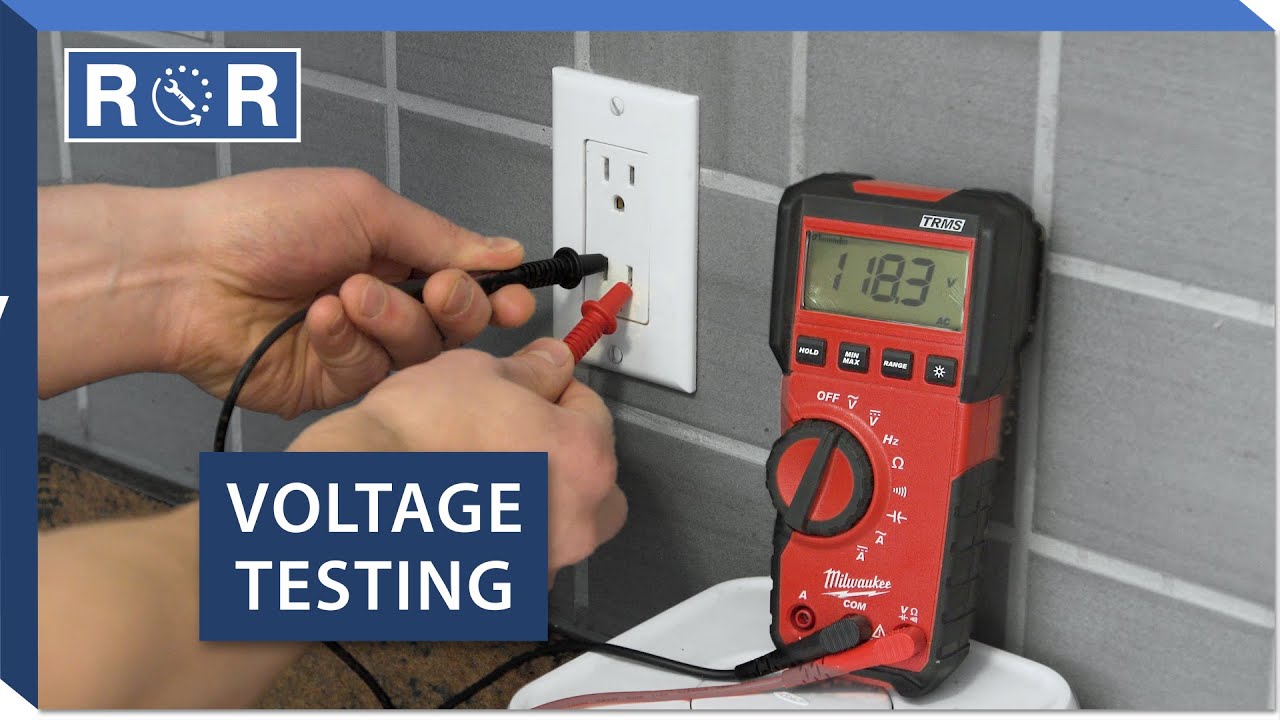
- Insert the black probe into the wide (neutral) slot.
- Insert the red probe into the narrow (hot) slot.
- Read the display: A typical North American outlet should read between 110V and 125V AC.
Example: When I tested a new outlet in my home, my digital multimeter read 121.3V, confirming normal operation.
Step 4: Test For Ground
To verify grounding:
- Move the black probe from the neutral slot to the ground slot (rounded hole).
- The voltage should still read close to 120V AC.
If you get a much lower reading, the outlet may have a grounding issue.
Step 5: Remove Probes Safely
Remove the probes one at a time, starting with the red (hot), then the black (neutral or ground). Turn off your multimeter.
Step 6: Interpret Results
- 110, 125V: Normal for U.S. outlets.
- Below 105V: Potential wiring or supply issue.
- No reading: Possible tripped breaker, faulty outlet, or wiring problem.

Credit: mrelectric.com
Common Issues Detected When Testing Outlets
Testing with a multimeter can reveal a variety of wiring issues and electrical faults. Understanding what your readings mean is crucial.
Outlet Voltage Problems
| Voltage Range | Likely Issue | Recommended Action |
|---|---|---|
| 110, 125V | Normal operation | No action needed |
| 90, 105V | Voltage drop, overloaded circuit | Check for high-demand appliances, consult electrician |
| 0V | Dead outlet, tripped breaker | Check breaker, inspect wiring |
| Above 130V | Wiring fault, transformer issue | Immediate professional inspection |
Polarity Problems
- Reverse polarity occurs if hot and neutral wires are swapped.
- Use the black probe in ground and the red probe in both hot and neutral slots:
- Hot, Ground: ~120V
- Neutral, Ground: ~0V
If you get reversed results, your outlet is wired incorrectly, a fire hazard that requires correction.
Grounding Issues
- No voltage between hot and ground: Missing or broken ground wire.
- Voltage between neutral and ground: Should be close to zero; higher readings suggest a shared neutral or wiring error.
Intermittent Or Flickering Readings
- Loose outlet connections can cause readings to jump or flicker.
- Inspect the outlet and wiring for wear, corrosion, or loose screws.
Pro Tip: Document your readings. Consistent or recurring faults should be reported to a qualified electrician.
Advanced Techniques And Troubleshooting For Experienced Users
For those with more experience, a multimeter can be a powerful diagnostic tool. Advanced measurements can reveal subtle problems invisible to basic tests.
Testing Outlet Frequency
Some DMMs can measure AC frequency. North American outlets should deliver close to 60 Hz; significant deviations can indicate generator or grid issues.
Measuring Voltage Drop Under Load
- Plug a known load (like a lamp) into the outlet.
- Measure voltage with the load on and off.
- A drop of more than 5% may indicate undersized wiring or overloading.
Checking For Ghost Voltage
Sometimes, a multimeter detects a small voltage when the circuit is supposedly off, known as ghost voltage. This is common in long runs with no load and can usually be ignored.
Warning: If you suspect ghost voltage, double-check with a solenoid tester or consult a professional.
Diagnosing Shared Neutrals And Multi-wire Branch Circuits
Advanced users may need to:
- Test for voltage between neutrals of different circuits.
- Identify shared neutral issues that can cause safety hazards or power imbalances.
Case Study: Diagnosing An Outlet With Intermittent Power
A homeowner reported that a kitchen outlet occasionally stopped working. Using a multimeter, an electrician measured voltage under load and found a significant drop (120V to 97V). Inspection revealed a loose wire in the outlet’s back-stab connection. Tightening the connection restored normal voltage and resolved the issue.
Comparing Multimeter Types For Outlet Testing
Choosing the right multimeter can greatly affect both safety and accuracy, especially for beginners.
| Feature | Analog Multimeter | Digital Multimeter |
|---|---|---|
| Display | Needle gauge | Digital LCD screen |
| Range Selection | Manual | Auto-ranging available |
| Accuracy | Lower (reading errors) | Higher (precise values) |
| Beginner Friendly | No | Yes |
| Cost | Lower | Varies (entry to pro) |
Pro Tip: For outlet testing, a digital multimeter with auto-ranging and a CAT II or III rating is ideal.
Real-world Examples: Practical Scenarios
Learning from real situations solidifies theoretical knowledge. Here are three practical examples:
Example 1: Confirming Outlet Voltage Before Installing A New Appliance
A homeowner wanted to install a new microwave and needed to confirm the outlet’s voltage. Using a digital multimeter, the voltage measured 123V AC, safe for the appliance. No electrical modifications were needed.
Example 2: Troubleshooting A Non-working Outlet
A user noticed that one outlet in the bedroom wasn’t powering devices. Testing with a multimeter showed 0V at the outlet, but 120V at the breaker panel. The issue was traced to a loose wire at a nearby outlet, which was fixed to restore power.
Example 3: Detecting Reverse Polarity
While updating old outlets, a DIYer tested for polarity. The multimeter showed 120V between neutral and ground, and 0V between hot and ground, signaling reversed wires. The outlet was rewired for safe operation.
Tips For Beginners: Building Confidence And Skill
Starting with outlet testing can be daunting. Here’s a step-by-step approach for those new to multimeters:
- Start with low-risk circuits: Practice on a power strip or extension cord before testing wall outlets.
- Read the manual: Every multimeter is slightly different, understand your device’s symbols and functions.
- Double-check settings: Ensure you’re in AC voltage mode before inserting probes.
- Use one hand: Whenever possible, use one hand to avoid creating a path for current through your body.
- Ask for guidance: If you’re unsure, consult an experienced friend or a licensed electrician.
Pro Tip: Watch reputable YouTube tutorials or consult resources like the Wikipedia Multimeter page for visual demonstrations.
Advanced Suggestions: Going Beyond The Basics
Once you’re comfortable, you can use your multimeter for more complex diagnostics and maintenance.
Testing Gfci And Afci Outlets
- GFCI (Ground Fault Circuit Interrupter): Test voltage as usual. Use the “Test” button on the outlet to ensure it trips and resets properly.
- AFCI (Arc Fault Circuit Interrupter): Measure voltage; if tripped, you’ll read 0V. These are common in bedrooms and newer homes.
Logging Voltage Over Time
Advanced models support data logging, allowing you to monitor voltage fluctuations over hours or days. This can reveal issues like voltage sags during peak usage.
Integrating With Smart Home Diagnostics
Some smart multimeters transmit data via Bluetooth, enabling remote monitoring or integration with home automation systems.
Regular Maintenance Checks
- Test all outlets annually to ensure safety and performance.
- Check for voltage balance across different circuits.
Warning: If you ever detect unusual smells, heat, or visible damage during testing, stop immediately and contact a qualified electrician.
When To Call A Professional
While multimeters empower users, some scenarios demand expert intervention:
- Consistently abnormal readings (high, low, or zero voltage in multiple outlets).
- Repeated tripped breakers or blown fuses.
- Signs of burning, buzzing, or sparking outlets.
- Lack of confidence in interpreting results.
Pro Tip: The National Fire Protection Association (NFPA) recommends professional inspection for any suspected wiring issues. Visit the NFPA Electrical Safety page for official guidelines.
Frequently Asked Questions
What Should I Do If My Multimeter Shows Zero Volts At An Outlet?
If your multimeter reads 0V at an outlet, start by checking your home’s breaker panel, you may have a tripped breaker or blown fuse. If the breaker is fine, the outlet may have a loose or disconnected wire. Inspect other outlets on the same circuit, as issues often cascade. For persistent problems, consult a licensed electrician to avoid fire hazards or further electrical faults.
Can I Damage My Multimeter By Testing An Outlet Incorrectly?
Yes, using your multimeter improperly, such as setting it to current (A) instead of voltage (V~), can blow the device’s internal fuse or permanently damage the meter. Always double-check your settings before testing, and ensure you’re using a meter rated for at least CAT II environments. If your meter stops working after a test, check the fuse and consult the manual for troubleshooting.
What’s The Difference Between Using A Voltage Tester And A Multimeter On An Outlet?
A voltage tester (or “test pen”) simply detects the presence of voltage, indicating whether an outlet is live. A multimeter provides precise numerical voltage measurements and can also test for polarity, ground, and continuity. For detailed diagnostics and troubleshooting, a multimeter offers far more information than a basic tester.
How Can I Test If My Outlet Is Properly Grounded?
To check for grounding, insert one probe into the hot (narrow) slot and the other into the ground (rounded) slot. The reading should be similar to the hot-neutral voltage (typically 110, 125V in the US). A reading close to zero or significantly lower than the expected voltage indicates a missing or faulty ground connection. Proper grounding is crucial for safety and should be corrected by a professional if absent.
Are There Any Outlets I Should Never Test With A Consumer Multimeter?
Yes, avoid testing high-voltage outlets (such as 240V dryer or oven outlets) unless your multimeter is explicitly rated for higher voltage and CAT III or IV environments. Industrial, three-phase, or specialty outlets should only be tested by professionals with appropriate equipment. Always check your multimeter’s specifications and consult a pro for unfamiliar or non-standard outlets.
Testing outlets with a multimeter, when done safely and knowledgeably, is a practical skill that boosts both safety and confidence for homeowners, students, and professionals. With the right tools, preparation, and respect for electricity, you can troubleshoot most common issues without risk.
However, always respect your limits, when in doubt, reach out to a certified electrician. Remember, no measurement is worth your safety.