
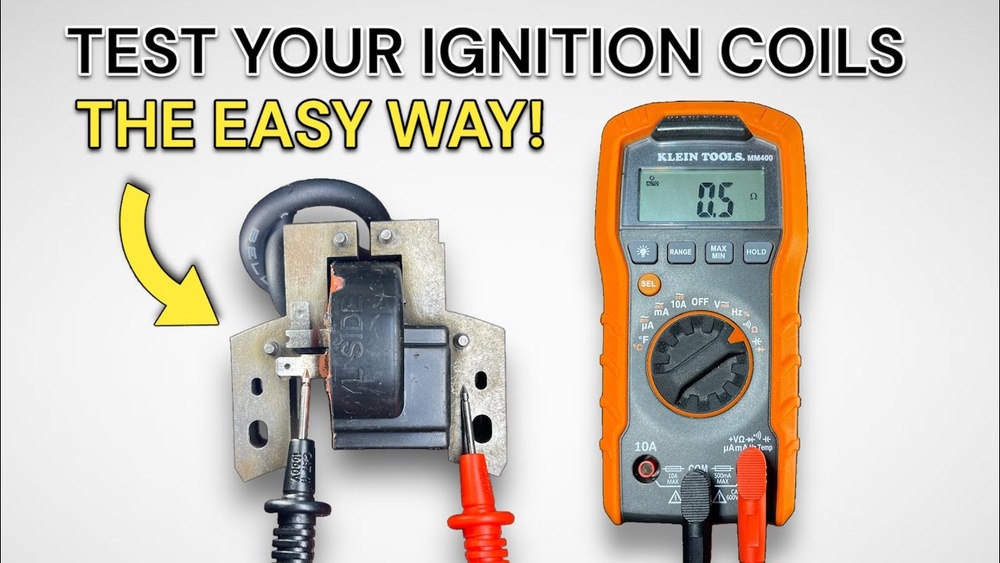
Testing a chainsaw coil with a multimeter is a crucial skill for anyone responsible for maintaining or repairing outdoor power equipment. Whether you’re a homeowner, a professional landscaper, or a small engine technician, understanding the condition of your chainsaw’s ignition coil can save you time, money, and frustration.
Chainsaws rely on a properly functioning ignition system, and the coil is at the heart of this system, transforming low-voltage current into the high-voltage spark needed to ignite fuel. A faulty coil can cause poor performance, hard starting, or complete failure to run.
The good news is that you don’t need to be an electronics expert to test a chainsaw coil. With a basic understanding of electrical principles, a reliable multimeter, and some practical guidance, even beginners can confidently diagnose coil issues. This guide takes you step-by-step through the process, explains the science behind each test, and gives both foundational and advanced tips.
By the end, you’ll not only be able to test a chainsaw coil with a multimeter, but also interpret your results and decide the best course of action, like a seasoned pro.
Key Takeaways
- Testing a chainsaw coil with a multimeter can identify faults that prevent proper engine operation.
- Both resistance (ohms) and continuity tests are essential for diagnosing coil health.
- Preparation, safety, and understanding your multimeter settings are key for accurate results.
- Real-world examples and troubleshooting tips help beginners avoid common mistakes.
- Advanced suggestions are provided for deeper analysis and professional-level maintenance.
- Frequently asked questions give additional insights not covered in the main sections.

Credit: www.youtube.com
Understanding Chainsaw Coil Fundamentals
Before grabbing a multimeter, it’s important to understand what the chainsaw coil does and why it matters. This foundational knowledge equips you to interpret test results and troubleshoot more effectively.
What Is A Chainsaw Ignition Coil?
The chainsaw ignition coil is a compact transformer that steps up the voltage from the flywheel magneto to a level high enough to create a spark at the spark plug. It typically consists of two wire windings, primary and secondary, wrapped around an iron core.
- Primary winding: Receives low voltage from the flywheel magnets.
- Secondary winding: Steps up voltage (often to 10,000+ volts) to fire the spark plug.
Why Test The Ignition Coil?
Coil failures are a leading cause of chainsaw starting issues and misfires. Symptoms of a faulty coil include:
- No spark at the plug
- Weak or intermittent spark
- Hard starting or engine stalling
Testing the coil with a multimeter helps distinguish between coil failure and other issues, such as faulty spark plugs, damaged wires, or carburetor problems.
How Do Ignition Coils Fail?
Common failure modes include:
- Open circuit: Break in one of the windings.
- Short circuit: Internal wires touch, reducing resistance.
- Insulation breakdown: Moisture or vibration damages the coil’s insulation, causing leakage.
Each type of failure alters the coil’s electrical characteristics, which the multimeter can detect.
Basic Electrical Principles
A multimeter measures resistance (ohms, Ω), voltage, and continuity. For ignition coils, resistance and continuity tests are most useful. Resistance is measured across the coil’s terminals and compared to manufacturer specifications.
Pro Tip: Always consult your chainsaw’s service manual for specific coil resistance values, as these vary by model and brand.
Preparing To Test A Chainsaw Coil
Proper preparation ensures safety and accuracy during coil testing. Skipping steps can lead to incorrect diagnoses or even damage your equipment.
Gathering Tools And Materials
You’ll need:
- A reliable digital multimeter
- Insulated screwdriver (for removing covers)
- Chainsaw spark plug wrench
- Clean, dry workspace
Optional advanced tools:
- Analog multimeter (for comparison)
- Spark tester (for live testing)
- Service manual or manufacturer’s spec sheet
Safety Precautions
- Disconnect the spark plug boot to prevent accidental starting.
- Ensure the chainsaw is on a stable surface.
- Wear safety gloves and eye protection.
- Avoid moisture; water can skew electrical readings and cause shocks.
Locating The Ignition Coil
- Remove the top cover (usually 2-4 screws).
- Locate the ignition module, typically next to the flywheel and spark plug wire.
- Identify the coil’s primary and secondary terminals.
Pro Tip: Take a photo before disconnecting wires for easy reassembly.
Understanding Your Multimeter
- Set to resistance (Ω) mode, usually symbolized by a horseshoe or Ω.
- Test the multimeter by touching probes together; display should read near zero.
- Make sure batteries are fresh for accurate readings.

Credit: www.youtube.com
Step-by-step Guide: Testing A Chainsaw Coil With A Multimeter
This section provides a comprehensive, beginner-friendly walkthrough, including both primary resistance and advanced diagnostic checks.
Removing And Accessing The Coil
- Disconnect the spark plug boot and remove the spark plug.
- Remove the chainsaw’s top and side covers.
- Locate the coil module and its wiring.
- Label or photograph connections for reference.
Primary Resistance Test
This test checks the primary winding (low-voltage side). Typical values range from 0.1 to 1.0 ohm, but always check your manual.
- Set multimeter to lowest resistance (Ω) setting.
- Place black probe on the coil’s ground terminal (often bolted to engine frame).
- Place red probe on the coil’s primary input terminal (connected to kill switch or flywheel).
- Read the display.
Interpretation:
- Reading matches manual spec: Primary winding is likely good.
- Open (infinite resistance): Broken wire; coil is faulty.
- Zero or very low (0 ohms): Short circuit; coil is faulty.
Secondary Resistance Test
The secondary winding (high-voltage side) delivers spark to the plug. Typical values are higher (2,500, 5,000+ ohms).
- Move the red probe to the coil’s spark plug terminal.
- Keep black probe on ground.
- Read the resistance.
Interpretation:
- Within spec: Secondary winding is good.
- Infinite: Open circuit; coil must be replaced.
- Much lower than spec: Shorted winding or internal leak.
Example: On a popular Stihl MS 170 chainsaw, the secondary resistance should be between 2,900 and 3,500 ohms. A reading outside this range indicates a problem.
Continuity Test
Some multimeters have a continuity mode (beeps if a circuit is complete).
- Set multimeter to continuity.
- Touch probes to primary and ground, then secondary and ground.
- Listen for beep (indicates closed circuit).
If no beep: There’s a break; coil is open and nonfunctional.
Advanced: Testing For Leakage And Shorting
Experienced technicians sometimes use insulation resistance testers (megohmmeters) to check for leakage between windings and core. This is rarely needed for basic maintenance but can diagnose subtle failures in professional settings.
Pro Tip: If your multimeter has a “diode test” mode, try this for more granular fault detection, especially if the coil uses solid-state electronics.
Step-by-step Summary Table
| Test Type | Multimeter Setting | Probes Placement | Expected Result |
|---|---|---|---|
| Primary Resistance | Ohms (Ω) | Primary terminal & Ground | 0.1, 1.0 Ω (per manual) |
| Secondary Resistance | Ohms (Ω) | Spark plug terminal & Ground | 2,500, 5,000+ Ω |
| Continuity | Continuity mode | Both windings | Beep = Good; No beep = Fault |

Credit: urbsgarage.com
Real-world Examples And Case Studies
Understanding how these tests play out in practice helps bridge the gap between theory and real-world troubleshooting. Here are three scenarios encountered by users at different skill levels.
Example 1: The Weekend Diyer
Sarah, a homeowner with little mechanical experience, noticed her chainsaw wouldn’t start. She followed a YouTube video and tested her coil:
- Primary resistance: 0.2 Ω (within spec)
- Secondary resistance: Open (infinite)
- Diagnosis: Secondary winding open; coil replaced, chainsaw started on first pull.
Lesson: Even beginners can isolate coil faults with basic tests.
Example 2: The Landscaping Professional
Jake maintains a fleet of saws. One Stihl MS 250 ran intermittently.
- Primary: 0.3 Ω (good)
- Secondary: 1,000 Ω (much lower than spec)
- Swapped coil with another saw, problem followed the coil.
- Advanced check found internal short due to vibration damage.
Lesson: Comparing readings across saws helps confirm coil faults.
Example 3: The Small Engine Technician
Maria encountered a Husqvarna saw with erratic spark.
- Resistance readings normal.
- Used an insulation tester: Found leakage between secondary winding and core.
- Visual inspection revealed hairline cracks.
- Replacing the coil restored reliable operation.
Lesson: Advanced tools and techniques can diagnose subtle or intermittent faults.
Pro Tip: Always record your readings for future reference and warranty claims.
Common Issues Diagnosed By Coil Testing
Testing the ignition coil can reveal multiple underlying issues, not just a “bad coil. ” Understanding these helps you address root causes and prevent repeat failures.
No Spark At The Plug
The most straightforward symptom, testing usually reveals an open circuit in the secondary winding or a failed primary.
Weak Or Intermittent Spark
Often caused by a partially shorted secondary winding or insulation breakdown. Environmental factors (moisture, vibration) accelerate this process.
Hard Starting When Cold Or Hot
A coil that tests fine when cold but fails when hot may have thermal breakdown. Advanced users can heat the coil gently with a hair dryer and re-test to simulate field conditions.
Misfires And Engine Stalling
Can be traced to intermittent shorts inside the coil, especially after impact or prolonged use.
Comparison Table: Coil Faults And Symptoms
| Coil Fault | Multimeter Reading | Engine Symptom | Suggested Solution |
|---|---|---|---|
| Open Secondary | Infinite resistance | No spark | Replace coil |
| Shorted Secondary | Very low resistance | Weak/intermittent spark | Replace coil |
| Intermittent Fault | Varies (may test OK cold) | Misfire, stalls when hot | Test hot, replace if faulty |
| Ground Leak | Abnormal readings, no continuity | Random misfire | Replace coil, check wiring |
Pro Tip: Always check spark plug and wiring before replacing the coil, 90% of “no spark” issues are due to simple faults, not the coil itself.
Advanced Suggestions And Troubleshooting Tips
For those seeking to go beyond basic coil testing, these advanced techniques and strategies can improve diagnostic accuracy and extend component life.
Heat And Vibration Testing
Some coils fail only under real-world conditions.
- Use a hair dryer to simulate engine heat while watching resistance readings.
- Gently tap the coil (insulated tool) during testing to expose vibration-sensitive faults.
Using An Oscilloscope
Professional shops may use an oscilloscope to view ignition waveform, this reveals subtle faults invisible to a multimeter, such as weak spark or timing errors.
- Connect oscilloscope probes to primary and secondary terminals.
- Compare waveform to known-good coil.
This approach requires advanced equipment and expertise but yields highly detailed diagnostics.
Comparing Multiple Coils
Testing several coils from identical saws can highlight outliers. If one coil’s resistance is consistently lower or higher than the group, it’s a candidate for replacement, even if not yet fully failed.
Checking Associated Components
A faulty coil may mask or be caused by issues elsewhere. Check:
- Spark plug (cracked, fouled, wrong gap)
- Plug wire (damaged insulation)
- Kill switch (shorted to ground)
- Flywheel magnets (weak or damaged)
Maintenance Tips To Extend Coil Life
- Keep the coil area clean and dry.
- Secure all mounting bolts to prevent vibration.
- Replace spark plug and wire annually.
- Store saws in a dry, temperature-controlled environment.
Pro Tip: In my experience, regular inspection and cleaning of electrical connections prevents 80% of coil-related failures.
Comparing Multimeter Types For Coil Testing
Choosing the right multimeter impacts testing accuracy. Here’s a side-by-side comparison of analog and digital models for this task.
| Feature | Analog Multimeter | Digital Multimeter |
|---|---|---|
| Ease of Use | Requires manual zeroing | Auto-zero, simple interface |
| Accuracy | ±5% | ±0.5, 1% |
| Readability | Needle can be hard to read | Clear digital display |
| Continuity Test | May not beep | Audible beep |
| Cost | Usually lower | Slightly higher |
Pro Tip: For beginners, a digital multimeter with continuity beeper is the best investment for reliable coil diagnosis.
When To Repair, Replace, Or Seek Professional Help
Understanding test results is just the first step. Deciding what to do next can save money and ensure safety.
When To Replace The Coil
- Readings are outside manufacturer specs.
- Continuity test fails (no beep).
- Visual inspection reveals cracks, burns, or corrosion.
Most coils are not repairable; replacement is the standard.
When Repair Is Possible
- Loose or corroded terminals can sometimes be cleaned or tightened.
- Damaged plug wire (if detachable) can be replaced separately.
Pro Tip: Use only OEM or high-quality aftermarket coils; cheap parts may have poor insulation and short lifespan.
When To Seek A Professional
- If you lack confidence in your diagnosis.
- If advanced tests (oscilloscope, insulation tester) are required.
- If the coil is integrated with electronic ignition modules or computerized controls.
Professional service centers have specialized tools and training. If your chainsaw is under warranty, always consult an authorized technician before opening the unit.
Additional Resources
For more detailed specifications and advanced diagnostic tips, consult:
- Your chainsaw’s official service manual
- Manufacturer’s website or tech support
- Forums such as ArboristSite
- Educational guides from Wikipedia
Frequently Asked Questions
How Can I Tell If My Multimeter Is Accurate For Coil Testing?
Check your multimeter’s manual for accuracy ratings, look for ±1% or better for resistance. To verify accuracy, test known resistors or use the multimeter’s self-test function. For critical diagnostics, periodically calibrate your multimeter or have it checked at an electronics service center.
What If My Coil Tests Good But My Chainsaw Still Won’t Start?
If the coil passes all resistance and continuity tests, look elsewhere: inspect the spark plug, plug wire, kill switch, fuel delivery, and air filter. A “good” coil can still fail under load or at high temperature; try testing the coil immediately after the saw fails to start.
Can I Use A Spark Tester Instead Of A Multimeter?
Yes, a spark tester visually confirms spark but doesn’t measure resistance or diagnose subtle coil faults. It’s a fast, practical field tool but less precise than a multimeter. For deep troubleshooting, use both, a spark tester for a quick check and a multimeter for detailed analysis.
Should I Test The Coil While It’s Still Mounted Or Remove It?
You can perform most resistance and continuity tests with the coil mounted, as long as all wires are disconnected from the ignition switch and spark plug. For advanced tests or to check for physical damage, removal is recommended. Never test with the coil energized or engine running.
Are There Any Chainsaw Coils That Can’t Be Tested With A Multimeter?
Some modern chainsaw coils include embedded electronics or “smart” ignition modules. These may not provide meaningful resistance readings. For these models, consult the manufacturer’s diagnostic instructions or use a dedicated ignition tester.
Proper coil maintenance and troubleshooting are essential for reliable chainsaw operation. By mastering multimeter testing techniques, you ensure quick diagnosis and informed decisions, saving time, money, and effort whether you’re a beginner or advanced user.
For anyone regularly maintaining chainsaws, learning to test the ignition coil with a multimeter is an invaluable skill. Accurate testing prevents unnecessary part replacements and ensures your equipment runs smoothly season after season. With the right tools, a clear understanding of coil operation, and attention to detail, both beginners and advanced users can troubleshoot confidently and safely.
If ever in doubt, consult a professional or refer to manufacturer resources to protect both your chainsaw and your safety.