

Testing fuses is a crucial skill for anyone who works with electronics, electrical systems, or automotive circuits. Whether you’re a hobbyist, a technician, or a homeowner troubleshooting a blown fuse in your car or appliance, knowing how to use a multimeter for this task can save time, money, and frustration.
This guide offers both beginner-friendly explanations and advanced recommendations, covering the fundamentals, real-world examples, and expert strategies for accurate fuse testing. By the end, you’ll understand how to confidently test fuses with a multimeter and interpret your results, no matter your experience level.
Fuses act as safety devices, protecting circuits from overcurrent by breaking the connection when current exceeds safe levels. When a circuit stops working, checking the fuse is often the first step. Multimeters, devices capable of measuring voltage, current, and resistance, are ideal tools for this job.
However, improper use can lead to misdiagnosis or even safety hazards, so mastering the process is essential. This article walks through everything from basic steps to advanced troubleshooting, ensuring you can approach fuse testing with expertise and confidence.
Key Takeaways
- Multimeters are reliable tools for testing fuses, suitable for both beginners and professionals.
- Continuity and resistance modes are commonly used to check fuse integrity.
- Proper technique ensures accurate diagnosis and prevents safety risks.
- Real-world examples and case studies demonstrate practical applications.
- Advanced tips help identify intermittent failures and select the right multimeter.
- Safety precautions are critical when testing live circuits or automotive systems.

Credit: www.youtube.com
Understanding Fuses And Their Role In Electrical Systems
Fuses are simple yet vital components designed to protect electrical circuits from damage caused by overcurrent. When current exceeds a fuse’s rating, its internal element melts, breaking the circuit and preventing further damage.
Types Of Fuses
There are several fuse types, each suited for different applications:
- Glass cartridge fuses: Common in electronics and appliances.
- Blade fuses: Widely used in automotive systems.
- Ceramic fuses: Found in high-voltage and industrial settings.
- Resettable fuses (PTC): Used in modern electronics for automatic protection.
Each type has unique characteristics regarding voltage, current rating, and physical size. Understanding these differences is essential for proper testing and replacement.
Why Fuses Fail
Fuses can blow due to:
- Overcurrent: Exceeding the rated current, typically due to short circuits or faulty devices.
- Age and fatigue: Repeated minor surges can weaken the fuse element over time.
- Mechanical damage: Physical stress or corrosion can impair function.
Recognizing the cause of failure helps prevent recurring problems after replacement.
Fuse Ratings And Specifications
Fuse ratings are printed on the body and include:
- Current rating (A)
- Voltage rating (V)
- Blow characteristics: Fast-blow or slow-blow, indicating response to surges.
Choosing the correct replacement is crucial for circuit protection and compliance with safety standards.
The Multimeter: Essential Tool For Fuse Testing
Multimeters are versatile instruments that measure electrical properties such as voltage, current, resistance, and continuity. They come in two main types: analog and digital.
Analog Vs. Digital Multimeters
The majority of modern users prefer digital multimeters (DMMs) due to their accuracy, ease of use, and display clarity. However, analog models still offer unique advantages in certain scenarios.
| Feature | Digital Multimeter | Analog Multimeter |
|---|---|---|
| Display | Numeric LCD | Needle gauge |
| Accuracy | High | Moderate |
| Price Range | $20-$200+ | $15-$100+ |
| Ease of Use | User-friendly | Requires interpretation |
| Durability | Varies by model | Generally robust |
Key Multimeter Functions For Fuse Testing
To test fuses, you’ll typically use:
- Continuity mode: Checks if electricity flows through the fuse.
- Resistance mode (Ohms): Measures the fuse’s resistance; a good fuse shows very low resistance.
- Voltage mode: Occasionally used for live circuit troubleshooting.
Understanding these functions is vital for accurate testing.
Selecting The Right Multimeter
Beginners should start with entry-level digital multimeters offering clear labeling and automatic range selection. Advanced users may prefer models with enhanced sensitivity, data logging, or advanced diagnostic features.
Pro Tip: Always choose a multimeter with safety ratings appropriate for your application (CAT II, CAT III, CAT IV) to protect against voltage spikes.

Credit: www.youtube.com
Step-by-step Guide: Testing Fuses With A Multimeter
Testing a fuse is a straightforward process, but following precise steps ensures reliability and safety. Below is a practical guide for beginners, followed by advanced suggestions for professionals.
Preparing For Fuse Testing
Before starting:
- Turn off power to the circuit or device containing the fuse.
- Remove the fuse from its holder, if possible.
- Inspect the fuse visually for signs of damage (burn marks, broken wire).
Using Continuity Mode
Continuity mode is the easiest way to check if a fuse is intact.
- Set your multimeter to continuity mode (symbol: Diode or sound wave).
- Touch the probes to each end of the fuse.
- Listen for a beep or check for a digital readout.
- Beep or 0 Ω: Fuse is good.
- No beep or infinite reading: Fuse is blown.
Testing Resistance
For a more precise measurement:
- Set your multimeter to resistance mode (Ω).
- Connect the probes to both ends of the fuse.
- Observe the resistance value.
- Low resistance (typically <0.5 Ω):Fuse is functional.
- High/infinite resistance: Fuse is blown.
Advanced Techniques: In-circuit Testing
Sometimes, fuses are difficult to remove or are part of complex assemblies.
- Test in-circuit only if the device is fully powered off.
- Check for parallel paths; other circuit elements can affect readings.
- Use voltage mode to measure across fuse terminals if necessary, but exercise caution.
Warning: Testing live circuits poses risk, ensure you understand circuit layout and follow all safety protocols.
Troubleshooting Common Issues
- False readings: Can occur due to dirty contacts or parallel circuit paths.
- Intermittent fuse failures: Some fuses appear good but fail under load; use advanced multimeters with load simulation features for deeper analysis.
- Corroded fuse holders: Clean contacts before testing for reliable results.
Example: Automotive Fuse Testing
Automotive blade fuses are ubiquitous in vehicles. Here’s a real-world example:
- Remove the fuse from the car’s fuse box.
- Set the multimeter to continuity mode.
- Probe the two metal blades.
- A beep indicates the fuse is good; silence means it’s blown.
This method is effective for diagnosing electrical faults in cars, such as malfunctioning headlights or radio systems.
Example: Appliance Fuse Diagnosis
A homeowner suspects a blown fuse in a microwave:
- Unplug the appliance and remove the fuse.
- Set the multimeter to resistance mode.
- Probe both ends; a reading near zero means the fuse is intact.
This process prevents unnecessary appliance repairs and confirms the root cause of failure.
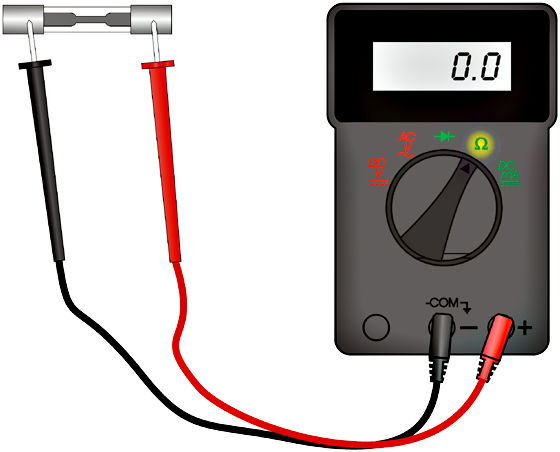
Credit: www.dinosaurelectronics.com
Real-world Case Studies And Examples
Practical applications help cement understanding of multimeter-based fuse testing. Here are three illustrative scenarios.
Case Study 1: Diagnosing A Dead Power Tool
A contractor’s drill stopped working suddenly. After verifying the power supply, he removed the fuse and tested it using a digital multimeter in continuity mode. The device emitted no beep, confirming the fuse was blown. Replacing the fuse restored operation.
Case Study 2: Troubleshooting Marine Electronics
On a fishing boat, GPS equipment failed. The technician used resistance mode to check the fuse, finding infinite resistance. The fuse appeared visually intact, but hidden corrosion had compromised its functionality. A new fuse resolved the issue.
Case Study 3: Industrial Panel Maintenance
In a manufacturing plant, a control panel malfunctioned. The maintenance team used in-circuit voltage testing, carefully measuring across fuse terminals with power off. The reading indicated a blown fuse, but further investigation revealed a secondary wiring fault, demonstrating the need for comprehensive circuit analysis.
Common Pitfalls And How To Avoid Them
Even experienced users can encounter mistakes when testing fuses. Awareness of pitfalls helps ensure accurate results.
Misinterpreting Multimeter Readings
- Zero resistance does not always mean a good fuse, parallel circuit paths can affect measurements.
- Digital display quirks: Old batteries or faulty leads can cause erratic readings.
Testing Live Circuits
- Never test fuses in live, high-voltage circuits unless you have advanced training and proper equipment.
- Use protective gear and follow OSHA safety guidelines.
Incorrect Multimeter Settings
- Setting the multimeter to the wrong mode (e.g., voltage instead of continuity) can yield misleading results or damage the instrument.
Example: A Beginner’s Mistake
In my experience, new users often forget to turn off the device before removing the fuse. This can lead to electrical shock or equipment damage. Always prioritize safety by disconnecting power first.
Advanced Techniques For Professional Fuse Testing
For technicians and advanced users, additional methods enhance diagnostic precision.
Load Simulation Testing
Some fuses fail only under load. Advanced multimeters can simulate operational currents, revealing weaknesses that basic tests miss.
- Connect the multimeter in series with a dummy load.
- Observe voltage drop across the fuse during simulated operation.
Oscilloscope Analysis
For critical circuits, use an oscilloscope to monitor fuse behavior under transient conditions. This helps identify slow-blow fuse issues and intermittent faults.
Data Logging And Trend Analysis
Modern multimeters with data logging can track fuse performance over time. This is invaluable in industrial settings, where repeated failures may indicate underlying circuit design flaws.
Selecting Fuses For Advanced Applications
- Consult manufacturer datasheets for fuse characteristics.
- Use fuses rated for specific environments (temperature, vibration).
Pro Tip: For medical or aerospace systems, use fuses certified by organizations such as UL or IEC for maximum reliability.
Safety Considerations When Testing Fuses
Safety is paramount when handling electrical components. Follow these guidelines for safe fuse testing:
Personal Protective Equipment (ppe)
- Wear insulated gloves and eye protection when working with high-voltage circuits.
- Use tools with non-conductive handles.
Safe Work Practices
- Always disconnect power before removing or testing fuses.
- Avoid touching exposed metal parts during testing.
- Keep the workspace dry and clear of flammable materials.
Multimeter Safety Features
- Choose models with overload protection, fused leads, and robust insulation.
- Check multimeter ratings before use in high-energy environments.
Regulatory Compliance
Adhering to standards (OSHA, IEC, UL) is essential for professional settings. Improper testing can result in injury or regulatory violations.
Warning: If unsure about circuit voltage or complexity, consult a qualified electrician or technician before proceeding.
Comparing Fuse Testing Methods: Multimeter Vs. Alternatives
While multimeters are widely used, other methods exist for checking fuses. Here’s a comparison table highlighting pros and cons.
| Method | Accuracy | Ease of Use | Safety | Cost | Notes |
|---|---|---|---|---|---|
| Multimeter | High | Beginner-friendly | Safe if used correctly | Varies ($20-$200+) | Versatile, precise |
| Test Lamp | Moderate | Simple | Safe with low voltage | Low ($5-$30) | Limited diagnostic info |
| Visual Inspection | Low | Very easy | Safe | Free | May miss hidden faults |
| Dedicated Fuse Tester | Moderate | Easy | Safe | Low ($10-$40) | Limited to fuse type |
Multimeters offer superior accuracy and versatility, but beginners may benefit from simpler methods for quick checks. For professional diagnostics, multimeters remain the gold standard.
Maintaining And Calibrating Your Multimeter
Regular maintenance ensures your multimeter remains reliable for fuse testing.
Cleaning And Storage
- Wipe down probes and body after use.
- Store in a dry, dust-free environment.
Battery Replacement
- Low batteries can cause inaccurate readings; replace as needed.
Calibration
- Annual calibration by a certified technician ensures accuracy.
- Advanced users may use calibration kits, but follow manufacturer guidelines.
Probe Care
- Inspect probes for damage or wear.
- Replace leads periodically to prevent false readings.
Pro Tip: Keep a log of calibration dates and battery replacements for professional multimeter maintenance.
Common Questions And Advanced Troubleshooting Tips
Experienced technicians often face challenging fuse failures that require deeper analysis.
Identifying Intermittent Faults
- Monitor fuse performance under varying loads and environmental conditions.
- Use multimeters with data logging to track trends.
Handling Difficult-to-reach Fuses
- Use extended probe leads or flexible connectors.
- Consider wireless multimeters for hazardous environments.
Upgrading To Professional Multimeters
- Features such as auto-ranging, temperature measurement, and wireless connectivity enhance diagnostics.
- Research models from reputable brands like Fluke, Klein Tools, and Extech.
Example: Industrial Troubleshooting
A factory technician faced repeated fuse failures in a motor control panel. Using a multimeter with load simulation and data logging, he identified voltage spikes as the root cause, prompting an upgrade to surge protection devices.
Frequently Asked Questions
What Is The Safest Way To Test A Fuse In A High-voltage Circuit?
For high-voltage circuits, always disconnect power before testing. Use a multimeter rated for the voltage category (CAT III or CAT IV) and wear appropriate PPE. In some cases, consult a licensed electrician to avoid risk.
Can I Test A Fuse Without Removing It From The Circuit?
Yes, but results may be affected by parallel paths in the circuit. For more accurate readings, it’s best to remove the fuse. If removal isn’t possible, ensure the device is powered off and check for continuity or voltage across the fuse terminals.
Is It Possible For A Fuse To Appear Good But Still Fail Under Load?
Absolutely. Some fuses degrade internally and pass basic continuity tests but fail when subjected to operational currents. Advanced multimeters with load simulation or monitoring features can detect these issues.
How Often Should I Calibrate My Multimeter For Fuse Testing?
For professional use, annual calibration is recommended. If you notice erratic readings or work in demanding environments, more frequent calibration may be necessary. Refer to manufacturer guidelines for specifics.
What Should I Do If I Suspect A Fuse Is Blowing Repeatedly?
Repeated fuse failures often indicate underlying circuit faults, such as short circuits, overcurrent, or defective components. Use your multimeter to check for abnormal voltages or currents, and consult a qualified technician for further diagnosis.
With a solid grasp of multimeter techniques and fuse diagnostics, you’re equipped to handle electrical troubleshooting confidently. Remember to prioritize safety, follow step-by-step procedures, and explore advanced features as your skills develop. Whether you’re working on a car, home appliance, or industrial system, effective fuse testing with a multimeter is a fundamental skill that empowers both beginners and experts alike.